
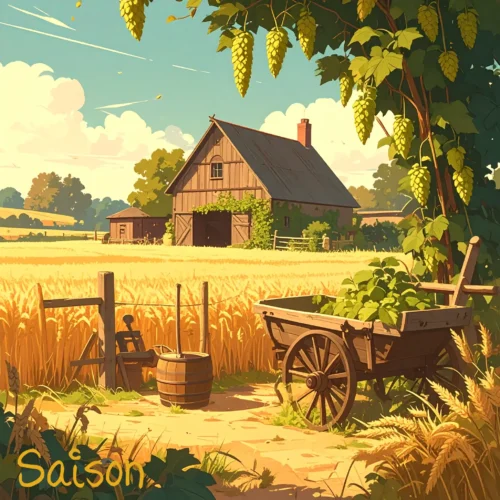
The Brew
I brewed this one on New Year’s Day, which felt appropriate for a saison. There’s something right about starting the year with a farmhouse beer: clean, dry, a little wild around the edges. The goal was a straightforward BJCP 25B: nothing clever, just trying to do the style properly.
This is my first brew with M29 French Saison. I wanted to let the yeast speak for itself from the start: a grist and hop selection that didn’t compete with it, just gave it room to do its thing.
The grist is built on Weyermann Barke Pilsner (4.2kg of it) with small contributions from wheat, rye, and Vienna. The rye is modest at 300g, just enough to add a little texture and spice without becoming the point. Hops are Saaz and Styrian Goldings, both classic saison territory. I added 300g of dextrose to push attenuation and keep the body on the dry side, which is exactly where I want a saison to finish.
How It Went
Brew Day
Mashed in at 63.5°C with 17L, which is on the low end for a reason: I wanted a highly fermentable wort to complement the dextrose addition and give the yeast every opportunity to finish dry. Rested for 75 minutes, ramped to mash out at 75°C over 10 minutes, held for another 10, then sparged 15L at 76°C. Mash pH came in at 5.3 and sparge pH at 5.6, which I was happy with.
Pre-boil volume was 29L off the BrewZilla 35L Gen 4. Boil ran 75 minutes: Saaz 33g at 60 minutes, Styrian Goldings 20g at 15 minutes and another 10g at flameout. Dextrose, Whirlfloc, and 4g of yeast nutrient all went in at the 10-minute mark. Post-boil I had 24.5L, with 23.5L into the FermZilla. OG landed right on target at 1.050.
Fermentation
M29 was moving within 12 hours, which is pretty typical for this yeast at a warm pitch temperature. I held the initial setpoint at 20–21°C and then let it free rise with the cooling trigger set at +4°C, which meant it could climb toward 25°C before the fridge kicked in. From there I gradually raised the temperature over the course of primary, finishing the ramp around 27°C and holding it there until around Day 12 or 13.
The RAPT pill tracked the whole thing and the attenuation was exceptional: it finished at 1.003 from a 1.050 OG, which works out to just under 94% apparent attenuation. That’s M29 doing what it does. Once I was confident fermentation was complete I disabled the heater and crashed to 3°C, holding for a day or two before kegging.
The Result
Kegged via closed transfer. The beer cleared well during the cold crash and poured bright. The aroma is everything you want from a saison: light pepper, a bit of citrus peel, slightly spicy with that dry farmhouse edge. Flavour is clean and bone dry, with the bitterness from the Saaz sitting quietly underneath without dominating. The rye adds a subtle texture; I’m not sure I could pick it out blind, but the mouthfeel feels right.
Tasting notes aside, the real verdict came from the Autumn Invitational BJCP competition, where this batch scored 45/50. That’s the closest I’ve come to nailing the style, and the judges placed it fifth overall for Best of Show. For a style I’m still actively developing, I’ll take it.
Next Time
I want to experiment with the hop selection. Saaz and Styrian Goldings are classic and they worked well here, but I’m curious what other varieties look like in a saison frame: whether a small addition of something more aromatic at flameout would complement the yeast character or just get in the way. One idea I’ve been thinking about: deliberately aging some hops, leaving them open in the fridge for a few weeks to oxidise slightly. That can introduce a cheesy, earthy note that works nicely in traditional farmhouse beers and might be worth exploring here.
The other thing I want to try is pushing the fermentation temperature ramp more aggressively early on. The gradual approach this time gave a clean result, but I’m curious whether a steeper rise in the first two or three days would coax more ester and phenol character out of M29, or whether it just gets messy. Worth a test.
And I’d like to try some other true saison strains at some point, partly just to understand what M29 is actually contributing versus what’s coming from the grist and process. A side-by-side with something like a dried Dupont culture or one of the liquid options would be interesting reference.